The AI Trap: A Tempting but Dangerous Shortcut
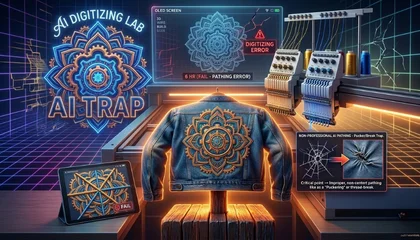
In the fast-paced world of 2026, automation is everywhere. For embroidery business owners, the promise of “Instant AI Auto-Digitizing” sounds like a dream come true. Imagine uploading a logo and getting a stitch file in seconds for just a few dollars. It sounds efficient, cost-effective, and modern. However, as the old saying goes, “If it seems too good to be true, it probably is.” Across the United States and the global market, professional embroiderers are waking up to a harsh reality: AI is not a master digitizer; it is a glorified tracing tool. While AI can recognize shapes, it lacks the fundamental understanding of physics, fabric tension, and machine mechanics. This gap in knowledge is silently draining the profits of thousands of embroidery shops.
The Mechanical Failure: Why AI Files Kill Machine Efficiency
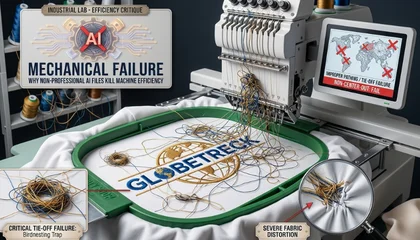
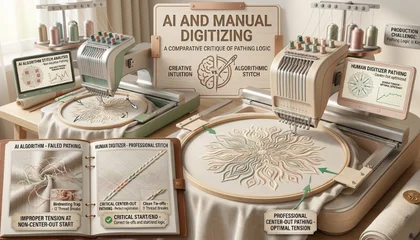
The biggest issue with AI-generated files is that they are “flat” interpretations of 2D art. An embroidery machine, however, works in a 3D environment where thread, needle, and fabric interact under high tension. AI software often produces “garbage pathing”—a chaotic sequence of stitches that makes your machine jump across the hoop unnecessarily.
In a professional environment, every second counts. AI files are notorious for having 50% more jump stitches than a manually digitized file. This doesn’t just slow down your production; it puts immense strain on your machine’s trimmer and motor. Furthermore, AI often struggles with “Stitch Logic.” It might place 5,000 stitches in a tiny one-inch area because it saw a complex color gradient in the original JPG. This excessive density leads to needle breaks, bird-nesting, and, in worst-case scenarios, can knock your expensive Tajima or Barudan machine out of timing.
The Fabric Nightmare: AI Can’t “Feel” the Stretch
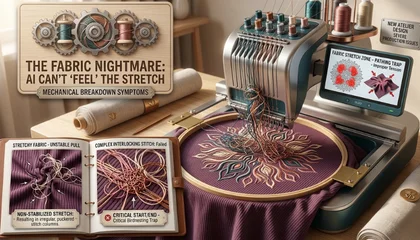
Ask any veteran embroiderer, and they will tell you that a logo digitized for a heavy canvas bag will never run correctly on a thin polyester performance polo. This is where AI fails completely. AI auto-digitizing software treats every surface the same way. It does not understand “Push and Pull” compensation.
When you embroider on a stretchy fabric, the stitches naturally pull the material inward. A human digitizer knows to “over-compensate” the width of the design so that once it’s off the machine, the circles stay round and the outlines align perfectly. AI software ignores these physical laws. The result? You spend hours hooping a expensive garment, only to have the final outlines miss the fill stitches by 2mm. You’ve just wasted a $40 blank and 30 minutes of production time—all to save $10 on a digitizing fee. In 2026, this is a mistake your business cannot afford to make.
Manual Precision: The Sassy Digitizing Standard
At Sassy Digitizing, we’ve seen the wreckage caused by AI files firsthand. We are often hired to “fix” files that clients tried to generate using “Instant” AI services. What makes us a top 10 embroidery digitizing company is our refusal to take shortcuts. We believe that a computer can’t feel the tension of a thread—but our master digitizers can.
Every single file that leaves our studio is hand-punched. We look at your artwork and ask: What fabric is this for? What machine will run it? What thread weight are you using? This manual approach allows us to create “Clean Pathing” that reduces jump stitches and optimizes your machine’s run-time. Our files are designed to be “Machine-Ready,” meaning you can load them and hit ‘Start’ with total confidence. Our Head of Quality Control, Keith Blair, ensures that every design undergoes a rigorous QA check to eliminate the errors that AI software naturally creates.
The True Cost of “Cheap” Digitizing
Let’s do the math. You buy an AI-generated file for $5. It takes 45 minutes to run because of the messy pathing. During that run, the thread breaks three times, and the needle breaks once. You have to stop the machine, re-thread it, and pray that the alignment holds. By the time the job is done, you’ve spent an hour on a 20-minute job.
Now, compare that to a professional digitizing service like Sassy Digitizing. You pay a fair price for a manually digitized file. The pathing is so efficient that the machine finishes in 18 minutes. There are zero thread breaks. The outlines are perfect. You finish three garments in the time it took the AI file to finish one. Which one is truly cheaper? In 2026, the real cost of digitizing isn’t the price of the file—it’s the cost of the time you lose at the machine.
The Sassy Commitment: Quality Assurance & Free Trials
We are so confident in the superiority of manual precision that we offer a first trial for free (under 5 inches). We want you to put our file on one machine and an AI file on the other. Watch the difference in the movement of the needle. Listen to the sound of the machine. The Sassy file will run smoothly, quietly, and fast.
Our 2-4 hour turnaround proves that you don’t need a robot to get speed. You just need a dedicated team of professionals who know what they are doing. We provide quality assurance that no algorithm can match. Whether you need a complex jacket back or a tiny logo for a performance cap, we provide the industrial-grade files your business deserves to scale.
Conclusion: Protect Your Brand in 2026
AI is a wonderful tool for many things, but it is not a replacement for a master craftsman. Your embroidery business is built on your reputation for quality. Don’t let “bulky” stitches, messy outlines, and machine downtime ruin that reputation. In 2026, the best embroidery digitizing service is one that combines human art with mechanical science. Choose Sassy Digitizing for the manual precision that keeps your machines running and your customers coming back.
Stop being a victim of AI errors. Invest in quality. Invest in manual digitizing. Let us show you why the most successful embroidery shops in the USA choose Sassy Digitizing for their production needs.
Frequently Asked Questions (FAQs)
1. Why does AI auto-digitizing cause thread breaks?
AI often creates “over-stitching” or clusters of stitches in a single point. This causes the needle to strike a hard surface of existing thread, leading to friction, heat, and eventually, a thread break.
2. Can AI handle small lettering?
No. Small lettering requires specific “Stitch Logic” and manual adjustments to pathing to ensure the letters don’t merge. AI simply traces the shapes, which almost always results in unreadable, messy text.
3. Is Sassy Digitizing a 100% manual service?
Yes. Every design is hand-punched by an expert digitizer who understands fabric physics and machine efficiency. We use software as a tool, not as a replacement for skill.
4. How can I test your manual digitizing quality?
We offer a first logo free trial (under 5 inches). You can upload your design on our website and experience the manual precision of Sassy Digitizing without any financial risk.
About the Author
Keith Blair | Senior Quality Control (HOD) Keith Blair serves as Head of Department for Quality Control at Sassy Digitizing, with 12 years of commercial embroidery experience. He specializes in stitch density, underlay construction, and pull and push compensation adjustments across all fabric types ensuring every digitized file is production-ready before it reaches the customer.