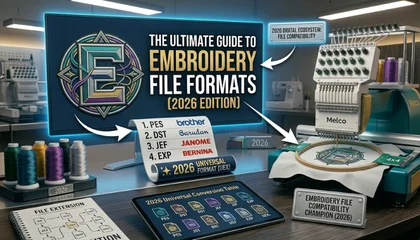
In the high-stakes world of textile manufacturing, the difference between a masterpiece and a mess often lies in a three-letter file extension. For over a decade, the industry has shifted from basic mechanical setups to complex digital ecosystems. If you are an embroiderer in 2026, understanding embroidery file formats is no longer optional—it is the foundation of your production’s bottom line.
Whether you are trying to digitize complex patterns for a boutique brand or executing high-volume custom 3D puff digitizing, the file format you choose dictates the machine’s behavior. In this expert-level guide, we will deconstruct the anatomy of stitch files and reveal why Sassy Digitizing is globally recognized among the top 10 embroidery digitizing companies.
1. The Anatomy of a Stitch File: Beyond Pixels
Most clients make the mistake of thinking an embroidery file is just an “image.” As a seasoned professional, you know that a JPG is a map of colors, but an embroidery file is a map of movements.
A true embroidery format contains:
Stitch Coordinates (X, Y): The exact geometric position for every needle penetration.
Machine Commands: Instructions for “Trims,” “Jumps,” and “Color Changes.”
Density Curves: Data that tells the machine how closely to pack the threads.
Without the correct format, your $15,000 Tajima or Brother machine is essentially blind.
2. Global Standards: The Industrial Powerhouses
When you step into a commercial factory, you won’t see PNGs. You will see “Stitch Data.”
DST (The Universal Language)
Developed by Tajima, the DST format is the “Latin” of embroidery. Almost every commercial machine on the planet can read it. However, experienced writers know its secret flaw: DST files do not store color information. * Expert Tip: If your machine shows a neon green logo as bright red on the screen, don’t panic. The stitch data is intact; you simply need to assign the color sequence manually on the machine’s control panel.
EXP (Melco & Commercial Speed)
The EXP format is preferred by many high-speed operators. It is lean, efficient, and carries minimal “metadata” bulk. This makes it ideal for machines that need to run at 1,000+ stitches per minute without lag.
3. Home & Boutique Formats: The Consumer Giants
If you are running a Brother, Babylock, or Janome, your requirements are different. You need “Rich Metadata.”
PES (The King of Home Embroidery)
The PES format is designed for Brother and Babylock machines. Unlike DST, a PES file stores the exact thread colors. This is crucial for hobbyists and small business owners who rely on the machine’s display to stay organized.
JEF and HUS (Janome & Husqvarna)
These are proprietary formats. If you are trying to digitize complex patterns for these machines, you must ensure your software’s “Hoop Limitation” settings are turned on. These machines are very sensitive to designs that exceed their specific sewing area.
4. Why Manual Digitizing is Better than AI in 2026?
As AI becomes more common, many “instant” digitizing tools have emerged. But here is the 15-year veteran’s perspective: AI cannot feel the fabric.
A machine learning algorithm can trace a line, but it cannot calculate the “Push and Pull” of a performance polyester versus a heavy denim. When you digitize complex patterns, you need a human to adjust the “Underlay” to stabilize the fabric.
At Sassy Digitizing, we reject the “Auto-Digitize” button. Every file we deliver is hand-punched. This manual precision is why we maintain our status as a Top 10 Best Embroidery Digitizing Company in the World. We create files that save your needles, reduce your thread breaks, and increase your profit margins.
5. Specialty Formatting: The 3D Puff Challenge
One of the most requested services in 2026 is Custom 3D Puff Digitizing. This requires a very specific type of file structure.
The Capping Secret: A standard file will leave foam sticking out of the ends. A professional 3D puff file includes “Capping” stitches that seal the foam.
Density Logic: We nearly double the density compared to flat embroidery to ensure the foam is completely invisible under the satin stitches.
6. How to Fix Common Technical Failures
If your machine is struggling, the issue is rarely the hardware; it’s usually the file’s “Pathing.”
How to Fix Embroidery Puckering
Puckering occurs when the stitch tension overrides the fabric’s stability. To fix this in your file:
Increase Pull Compensation.
Add a Contour Underlay to create a “grid” that locks the fabric in place.
How to Fix Slow Embroidery
If your machine is stopping every 30 seconds, your file has too many “Trims.” A professional digitizer organizes the “Pathing” so the needle moves logically from one object to the next without jumping across the hoop.
7. The Sassy Digitizing Difference
Why do the world’s leading brands trust Sassy Digitizing? Because we treat every file like a piece of engineering.
We provide the Best Embroidery Digitizing Service 2026 because we offer:
2 to 6 Hour Turnaround: Because in business, time is money.
Rush Orders (1-3 Hours): For those “I need it yesterday” clients.
Quality Assurance: Every file is test-stitched digitally before it reaches your inbox.
Free Trial: We offer a Free Trial for any first logo under 5 inches. We don’t just talk about quality; we prove it.
8. Frequently Asked Questions (FAQs)
Q: Can I convert a PES to a DST file myself?
A: Yes, most software can “Save As,” but be careful. Converting between formats can sometimes cause “Stitch Scaling” issues. It is always safer to have a professional digitizer re-export the file to maintain integrity.
Q: Why is my machine not reading the USB drive?
A: Ensure the drive is formatted to FAT32 and the file is in the root directory. Also, make sure the design does not exceed the maximum hoop size of your machine.
Q: Is manual digitizing more expensive?
A: Upfront, yes. But in production, it saves you hundreds of dollars by preventing ruined garments and broken needles.
9. Conclusion: Your Partner in Precision
The world of embroidery file formats can be overwhelming, but you don’t have to navigate it alone. Whether you are a small boutique or a global factory, Sassy Digitizing provides the technical expertise you need to succeed.
Ranked as a Top 10 Embroidery Digitizing Company in the World, we are committed to the art of the perfect stitch. Stop settling for “good enough” and start demanding excellence.
Upload your design to Sassy Digitizing today and let’s set a new standard for your brand!
About the Author
Keith Blair | Senior Quality Control (HOD) With over 12 years of hands-on experience in the commercial embroidery industry, Keith Blair leads the Quality Control team at Sassy Digitizing. Keith has a deep understanding of the technical “mechanics” of PES files. He ensures that every design—from 3D puff to delicate small lettering—is optimized for high-speed production on Brother machines. His goal is simple: Create files that stitch perfectly the first time, every time..