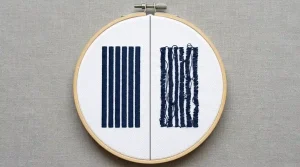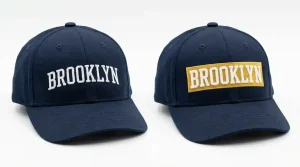
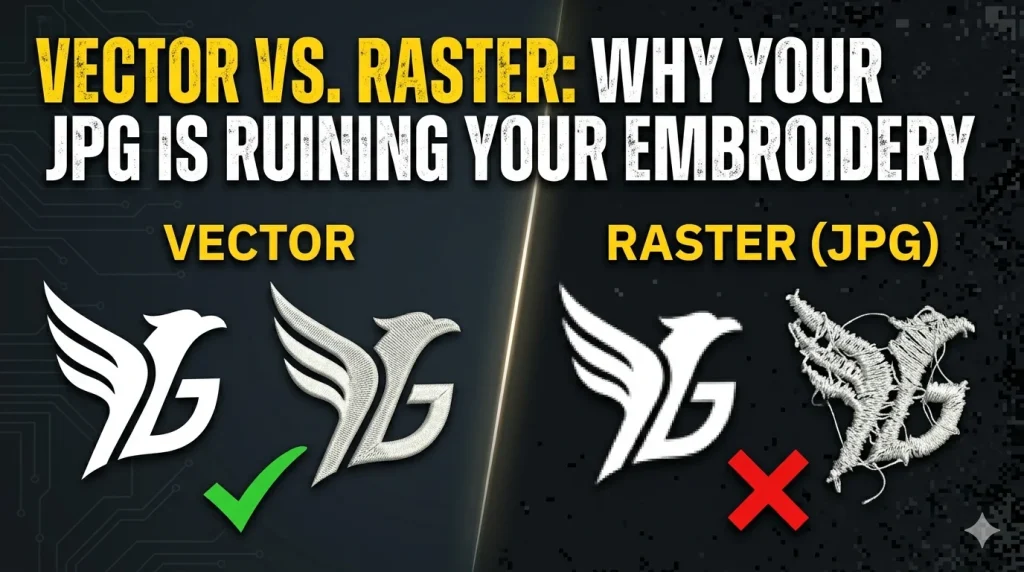
If you have ever tried to run a standard JPG logo through your embroidery machine only to end up with a mess of tangled thread and ruined fabric, you are not alone. In 2026, the biggest mistake a business owner can make is assuming that “if it looks good on a screen, it will look good on a shirt.”
The truth is, your embroidery machine doesn’t care about pixels. It doesn’t see colors the way your eyes do. It only understands paths and coordinates. This is the heart of the Vector vs. Raster for embroidery debate.
At Sassy Digitizing, we see hundreds of clients every week who are frustrated because their “free converter” gave them a “bulletproof” design that broke their needles. Today, we are going to break down why your JPG is your enemy and why professional manual digitizing is the only way to save your brand’s reputation.
1. What is a Raster Image? (The “Pixel” Problem)
JPGs, PNGs, and GIFs are all Raster images. They are made of thousands of tiny squares called pixels.
The Scaling Disaster: When you zoom in on a JPG, it becomes blurry and “pixelated.”
The Machine’s Confusion: When an embroidery machine tries to read a pixel, it doesn’t know where the edge of the line is. This causes jagged borders and messy “bird-nesting” under the fabric.
If you are trying to digitize complex patterns from a low-quality raster image, you are setting yourself up for failure. The machine will try to sew every single blurry pixel, leading to unnecessary thread buildup.
2. What is a Vector Image? (The “Path” Perfection)
Vectors (AI, EPS, SVG) are not made of pixels. They are made of mathematical paths—lines and curves that stay perfectly sharp no matter how much you zoom in.
For a digitizer, a vector file is like a high-definition map. It allows us to:
Define Clean Borders: We can see exactly where a satin stitch should start and stop.
Apply Accurate Pull Compensation: Because the lines are sharp, we can calculate exactly how much the thread will pull the fabric.
Optimize the Pathing: Clean vectors allow for a logical flow, reducing those annoying “jump stitches” that slow down your production.
3. Why You Can’t Just “Save As” a PES or DST
A common myth is that you can just take a JPG and “Save As” a DST or PES file. This is impossible.
Converting PNG to DST or PNG to PES is not a file change; it is a translation. You are translating a “Picture” into a “Set of Instructions.” This is where Sassy Digitizing excels. While AI tools try to “trace” the pixels, our master digitizers hand-punch every coordinate to ensure a Perfect Sew-Out.
4. Why Manual Digitizing is Better than AI in 2026?
In 2026, AI is everywhere. But AI doesn’t have a “sense of touch.”
AI doesn’t know fabric: It doesn’t know that a 3D Puff design on a hat needs more density than a flat logo on a tote bag.
AI creates “Stiffness”: Auto-converters often put 20,000 stitches where only 8,000 are needed. This makes the garment uncomfortable to wear.
As a Top 10 Best Embroidery Digitizing Company in the World, Sassy Digitizing relies on human expertise. We look at your design, understand the fabric you’re using, and manually set the density and underlay. This is why our files run 30% faster on industrial machines than AI-generated files.
5. Sassy Digitizing: The Global Solution for 2026
We don’t just talk about quality; we deliver it at a speed and price that leaves the competition in the dust.
Our Exclusive 2026 Benefits:
$1 per 1,000 Stitches: Premium quality doesn’t have to be expensive. We offer a flat, transparent rate.
2 to 6 Hour Turnaround: Your machines shouldn’t be sitting idle. We get your files back to you while your coffee is still warm.
Quality Assurance (QA): We don’t just send a file. We send a promise. Every file is checked for pathing efficiency and stitch balance.
Free Trial: Still using JPGs and hoping for the best? Send us your logo (under 5 inches) and we will digitize it for FREE. Experience a professional Sew-Out without spending a cent.
6. Specialty Services: Beyond Flat Embroidery
When you have a clean vector-based workflow, you can explore high-end techniques that charge a premium:
Custom 3D Puff Digitizing: Achieve that raised, retail-look on caps without foam peeking through the thread.
Micro-Digitizing: Perfect for 4×4 hoops where every millimeter of space is critical.
Jacket Backs: Large-scale designs that remain soft and flexible, not stiff like a board.
7. How to Fix Common “Raster” Errors
If you are stuck with a JPG and can’t get a vector, here is how we help:
Vector Art Services: We can take your blurry JPG and manually redraw it into a perfect vector before digitizing.
Density Mapping: We manually adjust the “Fill Stitches” to compensate for the lack of detail in the original image.
Pathing Audit: We remove the “noise” that raster images create, ensuring a clean, fast run on your Tajima, Brother, or Janome machine.
8. Frequently Asked Questions (FAQs)
Q: Can I use a high-resolution 300 DPI JPG for embroidery?
A: Even at high resolution, a JPG is still made of pixels. While it’s better than a blurry image, it still requires manual digitizing to become a usable stitch file.
Q: What is the best file to send to Sassy Digitizing?
A: We prefer AI, EPS, or SVG. However, if you only have a PNG or JPG, don’t worry—our team can handle the conversion for you.
Q: Why does my machine say “File Not Recognized”?
A: This usually happens when the file is not in the correct format (like trying to put a JPG on a USB for a Brother machine) or if the design exceeds your hoop size.
9. Conclusion: Quality Starts with the Right Foundation
Stop fighting with your machines and stop wasting expensive thread on poor-quality files. The Vector vs. Raster for embroidery battle is over: Vectors win every time, but only when they are backed by expert manual digitizing.
Join the thousands of US and global businesses that have scaled their production by partnering with a leader. Sassy Digitizing is more than a service; we are your production partner.
Ready for a perfect sew-out? Upload your design to Sassy Digitizing today and get your first logo digitized for FREE!
About the Author
Keith Blair | Senior Quality Control (HOD) Keith has over 12 years of experience managing large-scale embroidery production. He specializes in the mechanical relationship between thread, needle, and fabric. Now leading the QC team at Sassy Digitizing, Keith’s mission is to help embroiderers eliminate downtime by providing flawlessly digitized files.