The Challenge of Headwear Why Caps are Different
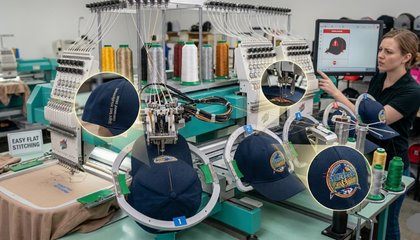
Digitizing for hats and caps is a completely different ballgame compared to flat garments like T-shirts or hoodies. The primary challenge lies in the curved surface and the seam that runs down the middle of most 6-panel caps. When the machine’s driver rotates the cap, the fabric naturally pushes and pulls in multiple directions. If your settings aren’t adjusted for this movement, you will face misaligned outlines, thread breaks, and bird-nesting. In 2026, achieving retail-quality headwear requires a deep understanding of stitch logic and specialized machine settings.
The Golden Rule Center-Out and Bottom-Up Pathing
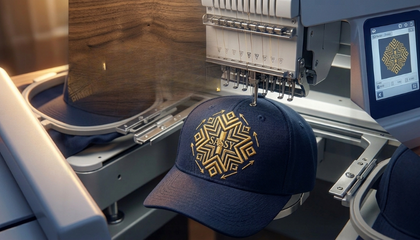
The most critical setting for cap digitizing is the stitching sequence. Unlike flat designs that often stitch from top to bottom, caps must be digitized from the center-out and bottom-up. Center-out pathing is vital because it pushes the fabric evenly toward the sides of the hoop. This prevents puckering or fabric bunching at the end of the design. Similarly, bottom-up pathing ensures that stitches start near the bill and move toward the crown. This anchors the cap to the stiffest part of the frame, ensuring the design does not shift as it moves higher.
Underlay Settings for Stability
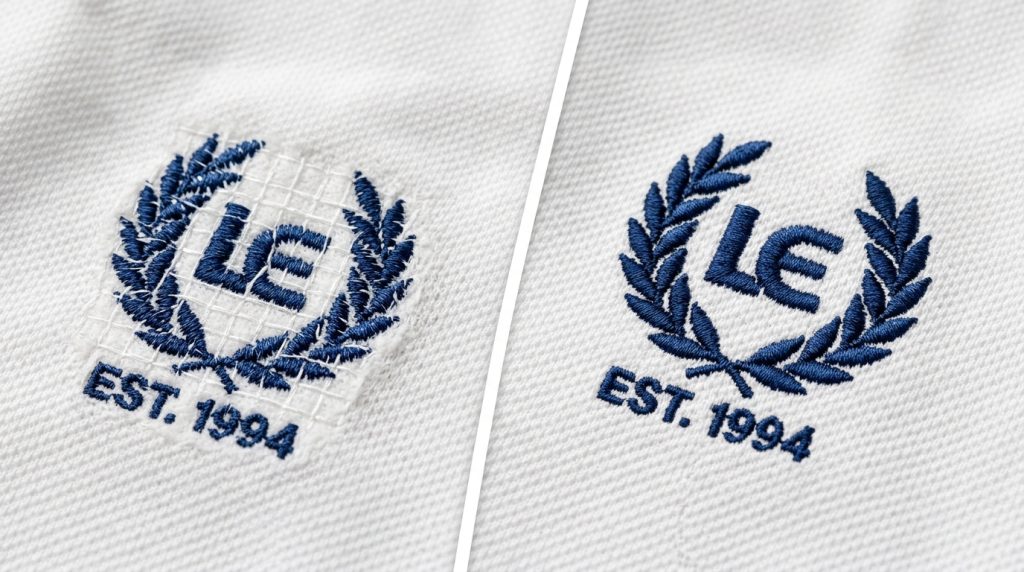
On a curved surface, the foundation is everything. You cannot rely on a simple center-walk underlay for caps. For satin stitches, you should always use a contour underlay to crisp up the edges. For larger elements, a zig-zag underlay provides the necessary lift and prevents the top stitches from sinking into the cap’s buckram. A professional tip is to avoid heavy fill underlays on structured caps. These make the design too stiff and can cause the needle to deflect or even break during a high-speed run.
Pull Compensation The Secret to Perfect Alignment
Because caps are under high tension on a rotary driver, the fabric pulls more than a flat garment. For 2026 production standards, we recommend increasing your pull compensation to 0.40mm or even 0.45mm. If you are digitizing a circle or a border around text, you must over-compensate the height. If you don’t, your circle will look like an oval once it is off the machine. At Sassy Digitizing, our manual precision approach ensures that every outline is mathematically adjusted to hit the mark perfectly, even on the most difficult 6-panel seam.
Density and Stitch Length Adjustments
Caps are usually made of heavy cotton twill or polyester blends. These fabrics can handle a bit more density, but you must be careful with small lettering. Keep your satin stitch density around 0.4mm. Also, ensure your stitch lengths are not too short. Stitches less than 1.5mm act like a drill on the cap’s stiff lining, leading to thread shredding and holes in the fabric. For 3D Puff embroidery on hats, you will need to double your density and add specialized capping stitches to cover the foam ends. This is a technical task that Sassy Digitizing experts handle daily with 100% accuracy.
Why Quality Digitizing Matters for Your Brand
A bad digitizing file will ruin expensive headwear blanks and waste your production time. This is why professional embroiderers in the US trust Sassy Digitizing. We provide production-ready files optimized for the curved geometry of hats. Our Head of Quality Control, Keith Blair, ensures that every cap file is tested for seam clearance and pathing efficiency.
To help you scale your headwear business, we offer a first trial for free. Whether it is a complex 3D puff logo or fine corporate text, we provide the quality assurance you need to run your machines at full speed. Our 2-hour turnaround means you never have to tell a client that their order is delayed.
Frequently Asked Questions (FAQs)
1. Why does my design shift when stitching over the center seam?
The center seam is the thickest part of the cap. If your pull compensation is too low or you are not using center-out pathing, the needle will push the fabric away from the seam, causing misalignment.
2. What is the maximum height for a hat embroidery design?
For most standard caps, the safe height is 2.25 to 2.5 inches. Going higher risks the needle hitting the metal frame of the cap driver, which can cause serious damage.
3. Do I need a special needle for cap embroidery?
Yes, we recommend using a 75/11 or 80/12 sharp needle. Sharp needles penetrate the stiff buckram of a hat much better than standard ballpoint needles.
4. Can I use the same file for a flat shirt and a cap?
Never! A file digitized for a flat shirt will almost always fail on a cap. The pathing, sequence, and pull compensation requirements are completely different for headwear.
About the Author
Keith Blair | Senior Quality Control (HOD) Keith has over 12 years of experience managing large-scale embroidery production. He specializes in the mechanical relationship between thread, needle, and fabric. Now leading the QC team at Sassy Digitizing, Keith’s mission is to help embroiderers eliminate downtime by providing flawlessly digitized files.